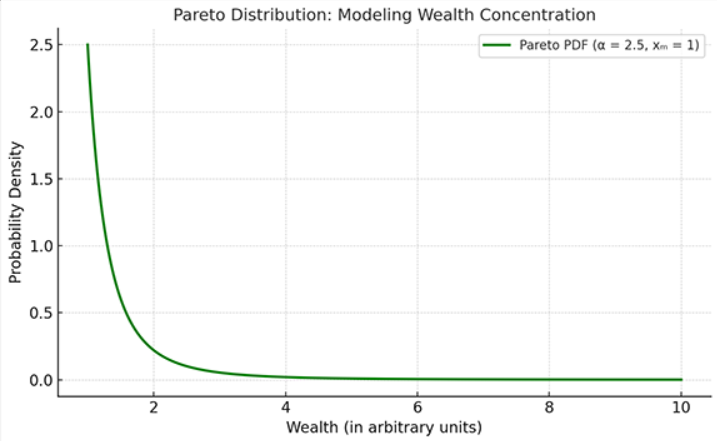

I’ve always thought that wealth inequality should be called “wealth diversity” because then it sounds like a good thing.
But seriously, folks, you’ve probably heard of the Pareto Principle, commonly known as the 80-20 rule. Vilfredo Pareto (1848-1923) noticed that in Italy in the early 20th century, about 20% of the population owned roughly 80% of the land, a skewed distribution that appears to be true for every society ever studied, regardless of governmental form.
Pareto distributions arise naturally from systems where positive feedback loops exist—for instance, wealth begets more wealth. Or as Jesus said in Matthew 25:29: “To those who have everything, more will be given; from those who have nothing, everything will be taken.”
The Principle of Unequal Distribution also applies, for example, to the population of cities (a very small number have almost all the people), the mass of heavenly bodies (a very small number hoard all the matter), and the frequency of words in a language (90% of communication occurs using just 500 words).