But I think American liberals have also made the mistake of focusing too much on income and wealth as the measures of success. Every chart and graph we see about America’s increase in “inequality” is about either money, or the likelihood of getting money. Sure, disparities of wealth are distasteful. Sure, money is one thing that confers social status. But by focusing on it obsessively, I think liberals are helping to cement its paramount importance as the end-all and be-all of social outcomes.
Dr. Douglas C. Engelbart (Photo credit: Wikipedia)
I often say, “Well, it’s just over on the other side of that canyon. So all we have to do is go.” It is always surprising to me that other people would expect me to tell them how we’re going to get there directly. That it is not enough to say, “Well, it would be important to get there and there is probably a way. Let’s go.”
Well I hope you come and see me in the movies
Then I’ll know that you will plainly see
The biggest fool that ever hit the big time
And all I gotta do is act naturally
1) There are lots and lots of people . . . Walking in Tokyo
Walking in TokyoWalking in TokyoWalking in Tokyo
2) Most of them are not very tall . . .
Giant among pygmies
3) Because there are a lot of people in a small amount of space (even though they are small people), Tokyo is built to take advantage of vertical space. For example, I’ve never seen a two- or three-story fast food restaurant in the U.S. but they’re common in Tokyo. Businesses that usually are two or three stories in the U.S., like department stores, in Tokyo are eight or ten stories.
Tokyo is a vertical cityIs that a McDonalds up there?SakeUeno Park
Matsumoto Castle (Matsumoto-jo) is one of Japan‘s premier historic castles. The building is also known as the “Crow Castle” (Karasu-jo) due to its black exterior. It was the seat of the Matsumoto domain. It is located in the city of Matsumoto, in Nagano Prefecture and is within easy reach of Tokyo by road or rail.
The keep (tenshukaku), which was completed in the late sixteenth century, maintains its original wooden interiors and external stonework. It is listed as a National Treasure of Japan.
The second floor of the main keep features a gun museum, Teppo Gura, with a collection of guns, armor, and other weapons.
Today was mostly a travel day, driving back to Tokyo from the lair of the snow monkeys. On the way back, we stopped at Matsumoto Castle, an impressive edifice built back in the late 1500s . . .
Jigokudani Monkey Park (Jigokudani Yaen Koen) is in Yamanouchi, Shimotakai District, Nagano Prefecture, Japan. It is part of the Joshinetsu Kogen National Park (locally known as Shigakogen), and is located in the valley of the Yokoyu-River, in the northern part of the prefecture. The name Jigokudani, meaning “Hell’s Valley”, is due to the steam and boiling water that bubbles out of small crevices in the frozen ground, surrounded by steep cliffs and formidably cold and hostile forests.
The heavy snowfalls (snow covers the ground for 4 months a year), an elevation of 850 metres, and being only accessible via a narrow two kilometre footpath through the forest, keep it uncrowded despite being relatively well-known.
It is famous for its large population of wild Japanese Macaques (Macaca fuscata), more commonly referred to as Snow Monkeys, that go to the valley during the winter, foraging elsewhere in the national park during the warmer months. Starting in 1963, the monkeys descend from the steep cliffs and forest to sit in the warm waters of the onsen (hotsprings), and return to the security of the forests in the evenings.
Today we ventured into the cold and hostile forests above Nagano to visit the legendary snow monkeys.
The monkeys aren’t friendly or unfriendly. They don’t approach you but they don’t try to stay away from you either. They might sit still for a selfie but they won’t smile.
Snow MonkeySnow Monkeys in Hot Springs (Onsen)
Yudanaka
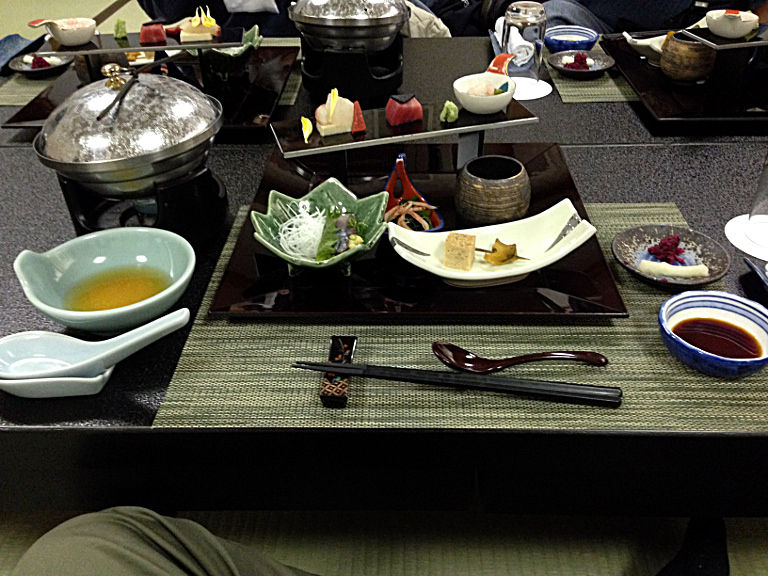
We stayed the night at a ryokan (bed and breakfast) in nearby Yudanaka Onsen, a hot spring resort, where we enjoyed traditional accomodations, including a multi-course Japanese dinner and sleeping on the floor (on tatami mats and futons).
Our room didn’t have beds but it did have a flat-screen TV. There’s a limit to how much deprivation up with which a traveler is willing to put.
Traditional Japanese MealOnsenTraditional Japanese Accomodations
The Tsukiji Market (Tsukiji shijo), supervised by the Tokyo Metropolitan Central Wholesale Market (Tokyo-to Chuo Oroshiuri Shijo) of the Tokyo Metropolitan Bureau of Industrial and Labor Affairs, is the biggest wholesalefish and seafood market in the world and also one of the largest wholesale food markets of any kind. The market is located in Tsukiji in central Tokyo.
There are two distinct sections of the market as a whole. The “inner market” (jonai-shijo) is the licensed wholesale market, where the auctions and most of the processing of the fish take place, and where licensed wholesale dealers (approximately 900 of them) operate small stalls. The “outer market” (jogai-shijo) is a mixture of wholesale and retail shops that sell Japanese kitchen tools, restaurant supplies, groceries, and seafood, and many restaurants, especially sushi restaurants.
There’s a temple near the market. We met these girls, who spoke a little English, not much. They were delighted to take photos with us. Japan is a friendly country. In California, if you asked strangers on the street to take a photo with you, I expect you’d get a mixed reaction.
They start making peace signs in photos very early in Japan. I saw kids as young as two years old doing it without being asked to. I asked our guide the reason for that and she said “Because we’re so happy.”
There is a long street lined with shops leading to the temple. Asakusa Senso-ji Asakusa Senso-ji Shop in Asakusa (100 yen = 1 dollar, roughly)
Across the street from the Senso-ji is the Asakusa Culture and Tourism Center, designed by Kengo Kuma. Mr. Kuma is an acclaimed Japanese architect, although to the untrained eye, the boards in the windows might give the impression that the building is under construction or renovation, neither of which is the case.
Asakusa Culture and Tourism Center
Imperial Palace
The Imperial Palace is the main residence of the Emperor of Japan. Twice a year — on New Year (January 2) and the Emperor’s Birthday — the public is permitted to enter the palace grounds. The imperial family appears on the balcony of the Chowaden Hall and the emperor normally gives a short speech greeting and thanking the visitors and wishing them good health and blessings.
If it’s not one of those two days (it wasn’t), the palace is closed, but you can still stand outside in the plaza and take a photo if you like.
Imperial Palace
Odaiba
Odaiba is a large artificial island in Tokyo Bay, Japan, across the Rainbow Bridge from central Tokyo. It was initially built for defensive purposes in the 1850s, dramatically expanded during the late 20th century as a seaport district, and has developed since the 1990s as a major commercial, residential and leisure area.
It’s December 25. Christmas is not a big deal in Japan. If you say “Merry Christmas” to people, they’ll say it back to you, if they understand English, but it’s not a holiday and stores and businesses are open. New Years is the big holiday here.
They do, however, have a lot of what we in the States would call Christmas lights, but in Japan are called “illuminations.”
Our hotel in Atami was on the eastern coast. Where we live in California, you can watch the sun set over the ocean every day if you want to, but here the sun rises over the ocean, which is a little bit different.
These photos are from the balcony of our room. If you look closely, you can see the United States in the background. It looks very small from this far away.
Japanese SunriseJapanese Dawn
Lake Ashi
We started the day on a sightseeing boat at Lake Ashi: Lake Ashi (Shinto shrine in foreground, Mount Fuji in background)
Owakudani
Owakudani (lit. “Great Boiling Valley”) is a volcanic valley with active sulphur vents and hot springs in Hakone, Kanagawa Prefecture, Japan. It is a popular tourist site for its scenic views, volcanic activity, and especially, Kuro-tamago (lit. “black egg”) — a local specialty of eggs hard-boiled in the hot springs. The boiled eggs turn black and smell slightly sulphuric; consuming the eggs is said to increase longevity. Eating one is said to add seven years to your life. You may eat up to two and a half for up to seventeen and a half years, but eating a whole third is said to be highly unadvised.
Owakudani is accessible via the Hakone Ropeway. In the States, we’d call this a tramway. I swear to god when I heard “ropeway” I thought we were going to have to pull ourselves up the mountain with a rope.
Hakone Ropeway
Our guide is on the right:
Hakone RopewayOwakudani
See the large buildings at the bottom of the photo below? Look up a bit from the one on the right and you’ll see the stand where the black eggs are cooked up and sold. It’s a short hike up the mountain.
OwakudaniOwakudani
We ate some black eggs:
Owakudani: Black Egg
They also have black ice cream:
Owakudani: Black Ice Cream
Mount Fuji
Mount Fuji (Fujisan), located on Honshu Island, is the highest mountain in Japan at 3,776.24 m (12,389 ft). An activestratovolcano that last erupted in 1707–08, Mount Fuji lies about 100 kilometres (60 mi) south-west of Tokyo, and can be seen from there on a clear day. Mount Fuji’s exceptionally symmetrical cone, which is snow-capped several months a year, is a well-known symbol of Japan and it is frequently depicted in art and photographs, as well as visited by sightseers and climbers. It is one of Japan’s “Three Holy Mountains” (Sanreizan) along with Mount Tate and Mount Haku; it is a Special Place of Scenic Beauty, a Historic Site, and was added to the World Heritage List as a Cultural Site on June 22nd, 2013.
As per UNESCO, Mount Fuji has “inspired artists and poets and been the object of pilgrimage for centuries.”
Kinkaku-ji (lit. “Temple of the Golden Pavilion”), officially named Rokuon-ji (lit. “Deer Garden Temple”), is a ZenBuddhist temple in Kyoto, Japan.
The site of Kinkaku-ji was originally a villa called Kitayama-dai, belonging to a powerful statesman, Saionji Kintsune. Kinkaku-ji’s history dates to 1397, when the villa was purchased from the Saionji family by ShogunAshikaga Yoshimitsu, and transformed into the Kinkaku-ji complex. When Yoshimitsu died, the building was converted into a Zen temple by his son, according to his wishes.
During the Onin war, all of the buildings in the complex aside from the pavilion were burned down. On July 2, 1950, at 2:30 am, the pavilion was burned down by a 22-year-old novice monk, Hayashi Yoken, who then attempted suicide on the Daimon-ji hill behind the building. He survived, and was subsequently taken into custody. The monk was sentenced to seven years in prison, but was released because of mental illnesses (persecution complex and schizophrenia) on September 29, 1955; he died of tuberculosis shortly after in 1956.
The present pavilion structure dates from 1955, when it was rebuilt.
— Wikipedia
Kinkakuji Temple: Golden Pavilion Kinkakuji Temple: Golden Pavilion Kinkakuji Temple: Golden Pavilion Kinkakuji Temple: Golden Pavilion Kinkakuji Temple: Golden Pavilion Kinkakuji Temple: Golden Pavilion Kinkakuji Temple Kinkakuji Temple: Golden Pavilion Kinkakuji Temple Kinkakuji Temple Kinkakuji Temple Kinkakuji Temple
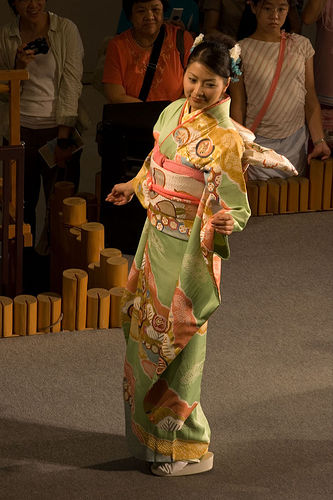
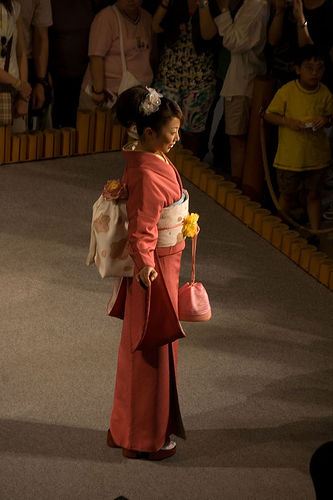
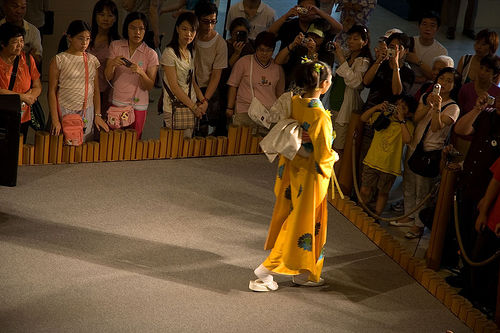
Nishijin Textile Center
Nishijin is a district in Kamigyo-ku, Kyoto, Japan, and (by extension) a traditional textile produced there, more narrowly referred to as Nishijin-ori (Nishijin fabric).
Nishijin weaving was created in Kyoto over 1200 years ago by using many different types of colored yarns and weaving them together into decorative designs. These specialized procedures are tedious, but necessary to obtain the spectacular design needed to ensure the quality of Nishijin weaving.
— Wikipedia
What the blurb above means is that images and patterns are not dyed after the fabric has been produced, the yarn is dyed before weaving, which yields the finest quality but is much harder to create.
Kimono Show Kimono Show Kimono Show
Tea Ceremony
We participated in a traditional Japanese tea ceremony, involving the preparation and presentation of matcha, a powdered green tea.
Fun fact: You don’t enter the tea room through that big opening in the front. You sort of crawl in through a small door on the right-hand side, which you can’t see in the photo. There’s a traditional reason for this, something to do with samurai not bringing swords to the tea ceremony (they won’t fit through the little door), but in modern times, it seems a bit of an unnecessary ordeal.
Tea Room
Bullet Train
We took the Shinkansen (bullet train) from Kyoto to Atami. These trains run on time. If the board says the train leaves at 3:12, it leaves at 3:12. Don’t show up at 3:13 and wonder where your train went.
Bullet Train Bullet Train
Atami
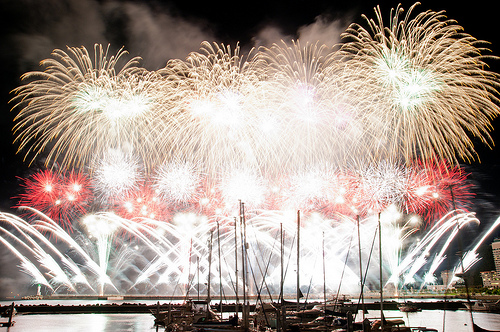
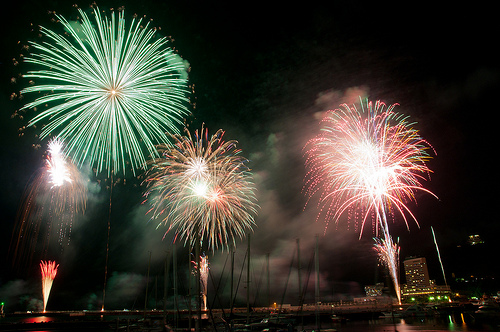
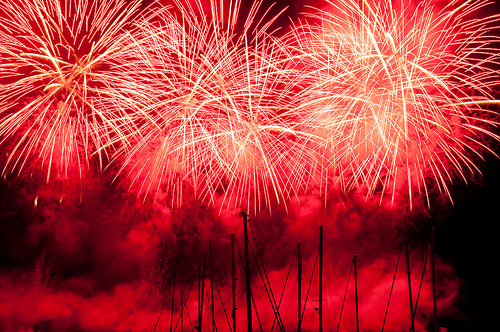
In Atami, we enjoyed a traditional Japanese dinner, so traditional that our guide was unsure of what a couple of the items were. Atami is on the eastern coast and has a spectacular fireworks display that they shoot off over the bay.
Traditional Japanese Dinner Atami FireworksAtami FireworksAtami Fireworks
The main tower of Osaka Castle is situated on a plot of land roughly one square kilometer. It is built on two raised platforms of landfill supported by sheer walls of cut rock, using a technique called Burdock piling, each overlooking a moat. The central castle building is five stories on the outside and eight stories on the inside, and built atop a tall stone foundation to protect its occupants from attackers.
In 1583 Toyotomi Hideyoshi commenced construction on the site of the Ikko-ikki temple of Ishiyama Hongan-ji. The basic plan was modeled after Azuchi Castle, the headquarters of Oda Nobunaga. Toyotomi wanted to build a castle that mirrored Oda’s, but surpassed it in every way: the plan featured a five-story main tower, with three extra stories underground, and gold leaf on the sides of the tower to impress visitors.
My son asks me, “Couldn’t invaders cross the moat on this bridge, just like we’re doing?”
“I’m going to go out on a limb here and speculate that the bridge was added in modern times, not as part of the original construction.”
Osaka Castle: Moat
We entered the castle through the Otemon Gate:
Osaka Castle: Otemon (Western) GateOsaka Castle: Main TowerOsaka Castle: Main Tower
There was a gentleman at the castle with a large supply of something or other that birds like to eat, so the birds followed him around:
Osaka Castle: The Birdman
He didn’t speak English but he kindly shared some of his bird food with us:
Osaka Castle: Feeding the birds
Todai-ji Temple
Todai-ji (Todai-ji, Eastern Great Temple), is a Buddhist temple complex located in the city of Nara, Japan. Its Great Buddha Hall (Daibutsuden), houses the world’s largest bronze statue of the Buddha Vairocana, known in Japanese simply as Daibutsu. The temple also serves as the Japanese headquarters of the Kegon school of Buddhism. The temple is a listed UNESCO World Heritage Site as “Historic Monuments of Ancient Nara“, together with seven other sites including temples, shrines and places in the city of Nara. Sika deer, regarded as messengers of the gods in the Shinto religion, roam the grounds freely.
We entered Todai-ji Temple through Nandaimon, the Great Southern Gate. In the photo below, the stand on the left sells biscuits you can buy and feed to the deer. More on that later . . .
Todai-ji Temple: Nandaimon, the Great Southern GateTodai-ji Temple: Nandaimon, the Great Southern GateTodai-ji Temple: Chumon GateTodai-ji Temple: Chumon Gate
Great Buddha Hall
According to records kept by Todai-ji, more than 2,600,000 people in total helped construct the Great Buddha and its Hall. The 16 m (52 ft) high statue was built through eight castings over three years, the head and neck being cast together as a separate element. The making of the statue was started first in Shigaraki. After enduring multiple fires and earthquakes, the construction was eventually resumed in Nara in 745,[8] and the Buddha was finally completed in 751. A year later, in 752, the eye-opening ceremony was held with an attendance of 10,000 people to celebrate the completion of the Buddha. The Indian priest Bodhisena performed the eye-opening for Emperor Shomu. The project nearly bankrupted Japan’s economy, consuming most of the available bronze of the time.
Todai-ji Temple: Great Buddha HallTodai-ji Temple: Great Buddha HallTodai-ji Temple: Great Buddha (Daibutsu)Todai-ji Temple: Great Buddha (Daibutsu)Todai-ji Temple: Buddha
Nara Deer Park
According to the legendary history of Kasuga Shrine, a mythological god Takemikazuchi arrived in Nara on a white deer to guard the newly built capital of Heijo-kyo. Since then the deer have been regarded as heavenly animals, protecting the city and the country.
Tame Sika Deer roam through the town, especially in Nara Park. Snack vendors sell “shika sembei” (deer biscuits) to visitors so they can feed the deer.
Nara Deer Park: Deer are not naturally aggressiveNara Deer Park: Deer are not naturally aggressiveNara Deer Park: Deer are not naturally aggressive
“Deer are not naturally aggressive if you’re not aggressive with them,” our tour guide says.
In other news, grass is green and water flows downhill. What would an aggressive deer do anyway? What sort of aggressive deer behavior should we be on the lookout for?
OK, I’ll tell you: You can buy shika sembei (deer biscuits) to feed the deer. Deer really like the deer biscuits. If you have biscuits, the deer will surround you and nibble on you. While you’re feeding the ones in front of you, the deer who couldn’t find room in front will nibble you from behind so they don’t get left out.
In fact, if the deer are not sure if you have biscuits or not, they may nibble on you anyway, usually in the area of your pockets, which would be an ideal place to conceal deer biscuits.
A good thing to know is that the deer do recognize and respect an open-handed, “See I don’t have any deer biscuits” gesture and will acknowledge it by not nibbling you.
These deer, sika deer, are regarded as messengers of the gods in the Shinto religion. If that is true, the message the gods are sending us is “More biscuits, please.”
Nara Deer Park: “More biscuits, please.”Nara Deer ParkNara Deer Park
Kiyomizu Temple
Kiyomizu-dera, officially Otowa-san Kiyomizu-dera is an independent Buddhist temple in eastern Kyoto.
Kiyomizu-dera was founded in the early Heian period. The temple was founded in 798, and its present buildings were constructed in 1633, ordered by the Tokugawa Iemitsu. There is not a single nail used in the entire structure. It takes its name from the waterfall within the complex, which runs off the nearby hills. Kiyomizu means clear water, or pure water.
Kiyomizu Temple: Main VerandaKiyomizu Temple: Nio-mon Gate and PagodaKiyomizu Temple: Nio-mon Gate and Pagoda
The temple complex contains several shrines, including the Jishu-jinja Shrine, known as the dwelling place of the god of love and matchmaking. Praying there is said to help one succeed in finding an appropriate love match.
Kiyomizu Temple: Jishu-Jinja Shrine
The temple is popular with young people looking for good fortune in love.
Actually, my son saw him. When the boy pointed him out to me, all I could see was the back of a smallish man in a black hoodie surrounded by half a dozen of the largest human beings I’ve ever seen. You have to get past those guys to get your shot at Floyd.
They were all standing on line at Panda Express in one of the food courts. Normally, I don’t envision famous, wealthy people eating Panda Express, and if they do, I don’t picture them standing on line for it. I picture them sending someone to fetch it while they hang out in the first class passenger lounge.
Good advertisement for Panda Express. Better than those ridiculous goddamn talking pandas.
“Duck Dynasty” star Phil Robertson has been put on an indefinite hiatus from filming the smash hit A&E reality series following inflammatory remarks about gay people he made in an interview with GQ magazine. . . .
In the interview, which appears in the January issue of GQ, Robertson, founder of the Duck Commander family business of duck calls, referred to gay people as “homosexual offenders” who would not “inherit the Kingdom of God.” He also said a woman’s vagina was “more desirable” than a man’s anus.
LET’S ENCOURAGE TOLERANCE AND DIVERSITY BY MAKING THIS GUY SHUT THE HELL UP!
Here’s Robertson’s full quote on “homosexual offenders”:
“Don’t be deceived. Neither the adulterers, the idolaters, the male prostitutes, the homosexual offenders, the greedy, the drunkards, the slanderers, the swindlers — they won’t inherit the kingdom of God. … Don’t deceive yourself. It’s not right.”
That’s a pretty accurate paraphrase of I Corinthians 6:9-10, which says
Know ye not that the unrighteous shall not inherit the Kingdom of God? Be not deceived: Neither fornicators, nor idolaters, nor adulterers, nor the effeminate, nor abusers of themselves with mankind, nor thieves, nor the covetous, nor drunkards, nor revilers, nor extortioners shall inherit the Kingdom of God.
A lot of people believe that’s the word of God. I don’t, but a lot of people do. In any case, it’s hardly extreme or “inflammatory.” It’s a bible verse. Why is it inflammatory to quote a bible verse as the word of God, but it’s totally cool to characterize Christian scripture as “vile”?
Also: you can’t be on TV if you find a woman’s vagina more desirable than a man’s anus?! A vagina is more desirable than an anus. That’s what keeps us going as a species.
A woman’s anus is more desirable than a man’s anus, but it’s not as desirable as a vagina. A man’s anus is a distant third in the desirability sweepstakes, and it’s even lower if you include mouths, sofa cushions, food products, etc.
This guy Robertson is on a “reality” show. That’s funny. There’s reality and then there’s “reality.”
He talks to a magazine and it turns out that in reality, he’s not as nuanced in his thinking as the people at GLAAD — whose job, by the way, is to be perpetually offended — would like him to be, and because of that, he can’t be on TV anymore.
Here’s a list of the members of the NYT editorial board, including academic major(s), which I obtained from their online bios. See if you notice anything unusual.
Andrew Rosenthal, Editor
(American History)
Terry Tang, Deputy Editorial Page Editor
(Economics, Law)
Robert B. Semple Jr., Associate Editor
(History)
David Firestone, Projects Editor, National Politics, the White House and Congress
(Journalism)
Vikas Bajaj, Business, International Economics
(Journalism)
Philip M. Boffey, Science
(History)
Francis X. Clines, National Politics, Congress, Campaign Finance
Did you notice that no one on that list, including the science editor, has a degree in anything related to math or science?
Now you might say, “Well, I’ve never heard of any of these people so why should I care what they think?” That’s a fair point.
But still, one has to give them credit for having made it in the big city, despite their lack of interest in math and science. So why encourage students to pursue educational goals that they themselves had no interest in, when this lack of interest has evidently not been a hindrance? Why is this a credible course of action?