Aside

Lunch-and-learn today on Developing a Positive Attitude. Was going to sign up but then thought, “What the heck good would that do?”

Thomas Jefferson’s Election 2012 Wrapup: Tired of the Bulls**t

 
Thomas Jefferson

My fellow Americans —

The first headline I saw this morning was Obama Victory Speech Urges Unity in Facing Challenges.

In case you haven’t seen it, here’s an ad run by President Obama in Ohio in the closing days of the campaign:

Not One of Us

A few days ago, it was Us vs. Them, whoever you imagine Us and Them to be. Now it’s Obama Urges Unity.

“Not one of us” is an ugly sentiment in itself, but coming from a man who not long ago promised us Hope and Change and Inclusiveness, it betrays a complete absence of character.

Four years ago, I said what I thought I needed to say to get elected, and I’m doing the same thing now, even though what I’m saying now is the exact opposite of what I said then.

Obama has been nothing if not divisive. On class and income, he speaks contemptuously of “millionaires” and glowingly of “spreading the wealth around.”

Obamacare, his signature “accomplishment,” allows — encourages, in fact — free riders to take advantage of others who’ll be forced to pay double and triple fares.

On race, he gratuitously inserts himself into cases involving black victims — Henry Louis Gates, Trayvon Martin, who “would look like my son if I had one.”

In cases where black boys beat a white man almost to death because they were bored, or black boys killed a white girl for bike parts, he has nothing to say — nothing about hate crimes, social disintegration or the resemblance of the perpetrators to his own hypothetical offspring.

Now that the election is over and won, he takes a few minutes for the obligatory call for unity before another four years of division.

I, for one, am tired of the bullshit.

Thomas Jefferson

The Good Society


Though it is disguised by the illusion that a bureaucracy accountable to a majority of voters, and susceptible to the pressure of organized minorities, is not exercising compulsion, it is evident that the more varied and comprehensive the regulation becomes, the more the state becomes a despotic power as against the individual. For the fragment of control over the government which he exercises through his vote is in no effective sense proportionate to the authority exercised over him by the government.

— Walter Lippmann, The Good Society

Politicians Making Things Happen


Now, if we want people to do certain things and if we are indifferent as to why they do them, then no affective appeals need be excluded. Some political candidates want us to vote for them regardless of our reasons for doing so. Therefore, if we hate the rich, they will snarl at the rich for us; if we dislike strikers, they will snarl at the strikers; if we like clambakes, they will throw clambakes; if the majority of us like hillbilly music, they may say nothing about the problems of government, but travel among their constituencies with hillbilly bands.

Mencken on Politicians

 
H. L. Mencken

The one aim of all such persons is to butter their own parsnips. They have no concept of the public good that can be differentiated from their concept of their own good. They get into office by making all sorts of fantastic promises, few of which they ever try to keep, and they maintain themselves there by fooling the people further. They are supported in their business by the factitious importance which goes with high public position. The great majority of folk are far too stupid to see through a politician’s tinsel. Because he is talked of in the newspapers all the time, and applauded when he appears in public, they mistake him for a really eminent man. But he is seldom anything of the sort.

Summary of Campaign Spending on California Ballot Propositions


I found this table from Ballotpedia rather interesting. It shows how much money has been donated to each side of the California ballot propositions.

Proposition Donations in favor Donations against
Proposition 30 $67,100,000 $53,400,000
Proposition 31 $4,400,000 $573,700
Proposition 32 $60,500,000 $73,300,000
Proposition 33 $17,100,000 $275,700
Proposition 34 $7,400,000 $391,900
Proposition 35 $3,700,000 $0
Proposition 36 $2,700,000 $119,900
Proposition 37 $8,700,000 $45,600,000
Proposition 38 $47,800,000 $42,300
Proposition 39 $31,400,000 $45,000
Proposition 40 $601,100 $2,300,000


HW’s Election Previews: Proposition 37

 
Crop Design - The fine art of gene discovery

From the Offical Voter Information Guide:

Requires labeling of food sold to consumers made from plants or animals with genetic material changed in specified ways. Prohibits marketing such food, or other processed food, as “natural.” Provides exemptions. Fiscal Impact: Increased annual state costs from a few hundred thousand dollars to over $1 million to regulate the labeling of genetically engineered foods. Additional, but likely not significant, governmental costs to address violations under the measure.

Notice this phrase: “Provides exemptions.” In other words, the statute requires certain things and prohibits certain other things — except when it doesn’t.

Not that it matters because $1 million a year isn’t going to buy you a lot of enforcement anyway. Who wrote this proposition, Dr. Evil?

Prop 37 is supported by people who hate freedom and having to think for themselves.

Worst Case Scenarios on Demand


If you’re in the market for a worst case scenario, you need to talk to my wife . . .

I got an Amazon Local deal via email — a one-hour horseback riding lesson for $35.

“Do you want to take a horseback riding lesson?” I asked her.

“No,” she said. “It’s dangerous. I’m not going to do it and you’re not going to do it. Remember that guy . . . what’s his name? Christopher Reeve.”

EppsNet Restaurant Reviews: Gulliver’s


The smoked salmon appetizer was superb, as was the prime rib entree.

Attentive service is provided by busty waitresses in the Brobdingnagian tradition.

“Did you notice all the waitresses had big tits?” my wife asked.

Highly recommended!

Favorite Poem of the Week


My favorite poem of the week — again from Modern & Contemporary American Poetry — was “Invasion of the Body Snatchers” by Bernadette Mayer, especially the final image of the stressed-out new mother reading The Wild Boy of Aveyron, about a feral child raised by wolves.

Visualizing Social Networks


I’m taking a Social Network Analysis class on Coursera. These weren’t assignments for the class (well, the Facebook one sort of was), just some experiments I wanted to share.

Facebook

You can use netvizz to download a gdf file of your Facebook network, i.e., all of your Facebook friends and all of the connections between them.

You can then use your favorite graph analysis software (I used Gephi, which is open-source and free) to look for patterns.

My Facebook network is in the image below. Of the four main clusters, two consist of co-workers, one is family and one is people I know from roller hockey.

Facebook network
Click image to enlarge

Twitter

This is the network of people I follow on Twitter. I used NodeXL (a free, open-source template for Excel) to download and lay out the data.

Twitter Network
Click image to enlarge

I labeled the nodes in this one. With a few exceptions, the light blue nodes are people I follow because I think they’re funny, the light green nodes are related to sports and/or USC, the dark green nodes are people of professional interest, the red nodes are former colleagues, and the dark blue nodes are everyone else.

The size of the node indicates number of tweets, i.e., larger nodes tweet more than smaller nodes.

LinkedIn

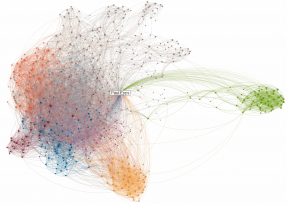
My LinkedIn network is a little bigger than my Facebook or Twitter. The green, yellow, blue, purple and orange clusters are co-workers and recruiters. The gray nodes at the top are people with whom I share one or more professional interests. You can see that they split out into multiple sub-groups.

LinkedIn network
Click image to enlarge

I used the LinkedIn Maps application to generate the graphic.

Summary

These are small-world networks and I had a good idea in advance about who was connected to who and why.

The value of tools like this is in applying them to “real world” networks. In the absence of analytical tools to extract patterns from raw data, large, complex networks just look like giant hairballs.

To give you an idea, this image shows what my Facebook network looks like in Gephi before applying a layout algorithm,

Facebook hairball
Click image to enlarge

Poems I’ve Read Recently and Liked


I’ve been reading a lot of poetry as part of the Modern & Contemporary American Poetry class on Coursera.

One of the things I like about the class is that the video lessons are done a little differently than other Coursera classes I’ve taken. Rather than recorded lectures, the videos consist of the instructor, Al Filreis, leading a small group of Penn students in close readings of selected poems.

Anyway, here are a few of my favorites so far:

These next two, both by Richard Wilbur, I want to single out as being particularly exquisite and heartbreaking:

Status
Paul Epps

A colleague says, “Are you talkin’ to ME?” Oh, and he showed up at work this morning with a shaved head. Time to worry?

Status
Paul Epps

RT @HarveyMackay: Once the mistake is recognized, what’s lost is lost#Mistakes

Status
Paul Epps

RT @dwangelo: Remember to vote! So it can be cancelled out by 50 million adults who enjoy Harry Potter books.

Status
Paul Epps

RT @DerrickAColeman: Everything Obama says is great, if he had done any of it in the last 4 years, I’d probably be voting for him.