Procrastination


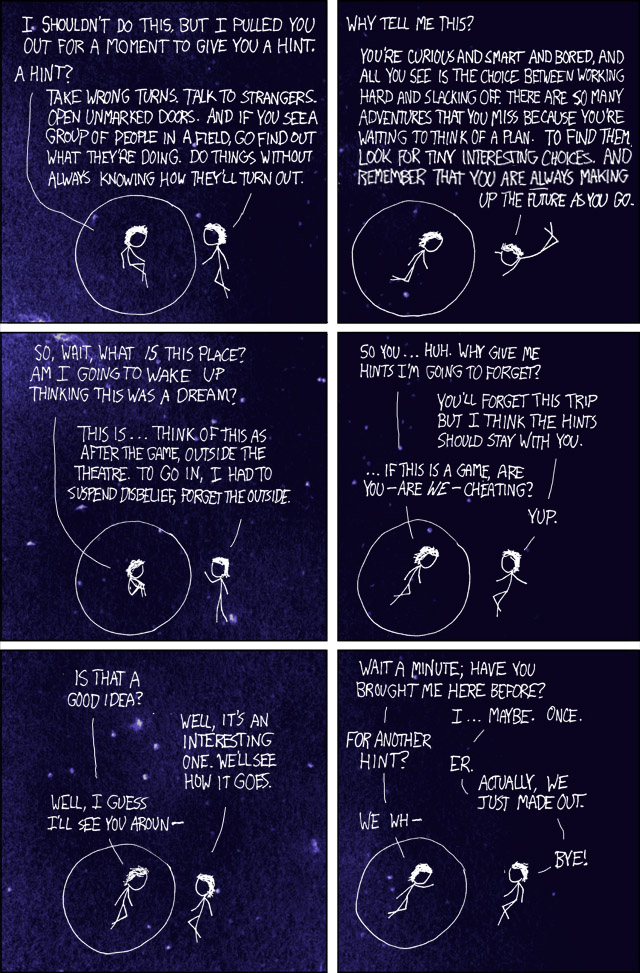
The most pernicious aspect of procrastination is that it can become a habit. We don’t just put off our lives today; we put them off till our deathbed.

Never forget: This very moment, we can change our lives. There never was a moment, and never will be, when we are without the power to alter our destiny.

— Steven Pressfield, The War of Art

The Finer Things in Life


One thing you can’t help noticing in spending a day at LACMA, what with the proximity to West Hollywood and all, is that gay guys really like art.

I mentioned that to my son and his response was “Case in point: you,” which wasn’t very nice.

He’s not much of an art lover . . . I admit that I occasionally drag him along to an art museum, because I feel like he should know at least a little bit about it whether he likes it or not.

On our way back to Orange County — in keeping with my mission of introducing the boy to the finer things in life — we stopped off at the original Tommy’s stand at Beverly and Rampart, not only an L.A. landmark, but a favorite of USC students for decades, where you can still get — as the boy did — a double chili cheeseburger, fries and a drink for $5.40.

Apologies to Pete Townshend, but I’d call that a bargain!

Coconut Pancakes


The Epps family was in Thai Town in Hollywood late Friday night. Most establishments were already closed . . . one exception was a Thai sweet shop called Bhan Kanom Thai, across the street from the famous Sanamluang Cafe.

There were three generations of Thai women in the shop: 1) A very cute, very poised 9-year-old girl, who probably could have run the place herself; her mom; and Grandma, who was cooking up some coconut pastries about the size, shape and consistency of silver dollar pancakes.

My wife walked out with about 25 dollars worth of the coconut pastries and other goodies.

When we got back on the 101 South, our son announced he was hungry.

“Try those coconut pancakes,” I said. “Best thing I ever tasted. I’m in heaven.”

“I don’t like coconut,” he said.

“How can you not like coconut?” my wife asked in alarm. “It’s a main ingredient in Asian food.”

“There’s no coconut in chow mein,” the boy said, by way of counterexample.

We couldn’t get him to try any, but that’s okay . . . more pancakes for me.

T.J. Simers Must Die


I thought sports columnists were appointed for life, like Supreme Court justices, no matter how irrelevant they become, and yet I see that the Los Angeles Times has just dumped J.A. Adande.

Well, by golly, that’s a good start!

I can’t think of a single print columnist, at the Times or elsewhere, who’s remotely relevant anymore. There are dozens of sports websites (not that one — start at Deadspin and follow the links) with at least an order of magnitude more energy, insight and wit than you’ll find in your local print rag, which is why newspapers are going the way of the 8-track tape, the buggy whip and whale oil.

The next in line to go at the Times should be fatuous blowhard T.J. Simers.

Simers positions himself as a pot-stirring wiseass, and the line on him seems to be that if people don’t like him, he must be doing something right.

Actually, nobody likes him because he’s a dull, uninformed, solipsistic clod, whose “style” consists of run-on sentences, juvenile name-calling, and endlessly repeated in-jokes and shout-outs that were never funny in the first place.

Up the Organization


You know what I saw at the bookstore this afternoon? A 35th anniversary edition of Robert Townsend’s Up the Organization!

If I’ve ever read a better business book, I can’t remember what it was. Townsend was way, way ahead of the curve in both style and content . . .

Highly recommended!

A Day at LACMA


We drove out to LACMA last weekend to see The Modern West: American Landscapes, 1890-1950, and Re-SITE-ing the West: Contemporary Photographs from the Permanent Collection.

I love exhibits like this . . . I’ve lived in California my whole life and I feel like these Western landscapes are part of my DNA.

While we were there, we also took in the Dan Flavin retrospective. Flavin’s work consists of standard fluorescent tubes arranged in patterns not beyond the imagination of the average six-year-old.

I tried viewing them up close, far away, from the side . . . I couldn’t make heads or tails of any of it.

LACMA helpfully provided a detailed theory of Flavin’s work in the form of a fold-out brochure with a lot of small print, but I didn’t read it. Isn’t art supposed to provide some sort of pleasure and/or illumination — pardon the pun — on its own merits?

I was reminded of Tom Wolfe’s epiphany in The Painted Word, that the distinction between, say, a Jackson Pollock painting and the splatterings of a kindergartener is that the kindergartener’s work lacks a persuasive critical theory:

All these years, in short, I had assumed that in art, if nowhere else, seeing is believing. Well–how very shortsighted! Now, at last, on April 28, 1974, I could see. I had gotten it backward all along. Not “seeing is believing,” you ninny, but “believing is seeing,” for Modern Art has become completely literary: the paintings and other works only exist to illustrate the text.

Another Reason I Never Put My Kid in Day Care


A day care worker in Tulsa, Okla., was looking after eight children ages 7 and younger.

One of the kids, a 2-year-old boy, would not be quiet for nap time, so she bound his hands and covered his mouth with masking tape.

That silenced him — permanently. The boy died after several days on life support.

I never did trust people enough to have them raise my kid. Never did.

Now if you were to respond that the average day care worker is no less capable than the average American mom of raising a child without killing it, I’d say — you’re probably right!

I’m just talking about my kid . . .

The Family and the Traditions and the Band

 
USC Trojans

I thought the corniest thing I’d ever heard when I got here was when they kept talking about this family that we had and I’d been at several other universities and I said, look they’re all the same. But they really believe it, they mean it and they live it and I’ve gotten caught up in that and the traditions and the band and I really don’t want to coach anyplace else. This is where I’d like to finish my career.

Fight On!

How Much I Care


We’re having dinner at Chili’s, and long before the food arrives, my kid has already informed me that I should have ordered meat instead of a salad, and that he can’t believe how quickly I ordered a refill on my soda.

“Are you going to micromanage the whole meal for me?” I ask. “I can’t see how it makes any difference to you what I order or how fast I drink my soda, but somehow it does.”

“It shows how much I care,” he says.

So Much for Dominating the White, Black and Hispanic Kids


My son and I are watching a Citibank commercial in which a woman in Japan drops her son off for his first day of school.

As his mom starts to walk away, the boy looks back anxiously . . .

“What’s the Asian kid nervous about?” my son says. “He’s going to get better grades than the rest of the kids anyway. Oh wait, all the other kids are Asian too. Ouch.”

Foundations of Mediocrity: Scheduling


My primary complaint about scheduling is simple: that people are willing to proceed as if they can look into a crystal ball about the future. They act as if they can plan out the future. As if they can control the future. It’s the control part that really gets to me. It bugs me because it’s a false belief. It’s simply not true. You can not control the future, and the belief you can is just so destructive of creativity, teamwork, spontaneity and interaction among one another. This false belief is just a complete energy zapper, an unwholesome energy sink.

This transcript of a Jim and Michele McCarthy podcast is the best discussion of scheduling I’ve read today, maybe ever . . .

Self-Reliance


To believe your own thought, to believe that what is true for you in your private heart is true for all men, — that is genius.


In every work of genius we recognize our own rejected thoughts: they come back to us with a certain alienated majesty. Great works of art have no more affecting lesson for us than this. They teach us to abide by our spontaneous impression with good-humored inflexibility then most when the whole cry of voices is on the other side. Else, to-morrow a stranger will say with masterly good sense precisely what we have thought and felt all the time, and we shall be forced to take with shame our own opinion from another.


God will not have his work made manifest by cowards.


Nothing is at last sacred but the integrity of your own mind.


Speak what you think now in hard words, and to-morrow speak what to-morrow thinks in hard words again, though it contradict every thing you said to-day. — ‘Ah, so you shall be sure to be misunderstood.’ — Is it so bad, then, to be misunderstood?


Let a man then know his worth, and keep things under his feet. Let him not peep or steal, or skulk up and down with the air of a charity-boy, a bastard, or an interloper, in the world which exists for him.


The sinew and heart of man seem to be drawn out, and we are become timorous, desponding whimperers. We are afraid of truth, afraid of fortune, afraid of death, and afraid of each other.


Welcome evermore to gods and men is the self-helping man. For him all doors are flung wide: him all tongues greet, all honors crown, all eyes follow with desire. Our love goes out to him and embraces him, because he did not need it.


A political victory, a rise of rents, the recovery of your sick, or the return of your absent friend, or some other favorable event, raises your spirits, and you think good days are preparing for you. Do not believe it. Nothing can bring you peace but yourself.

— Ralph Waldo Emerson, “Self-Reliance”