

Leaders who don’t care about people don’t have anyone to lead, unless their followers don’t have a choice.
Which Way is the Finish?
From the Mighty Rubber Ducky Derby at Wild Rivers in Irvine:

Originally uploaded by Spike in Irvine.
“Yesterday” by W.S. Merwin
My friend says I was not a good son
you understand
I say yes I understand
In Praise of Invective
Via Alicublog:
He writes the worst English that I have ever encountered. It reminds me of a string of wet sponges; it reminds me of tattered washing on the line; it reminds me of stale bean soup, of college yells, of dogs barking idiotically through endless nights. It is so bad that a sort of grandeur creeps into it. It drags itself out of the dark abysm of pish, and crawls insanely up to the topmost pinnacle of tosh. It is rumble and bumble. It is flap and doodle. It is balder and dash.
Tyler’s Puppy Face

Originally uploaded by amethystrainn.
ALOHA!

A friend is leaving tomorrow for a wedding in Hawaii. She asks me if I have any souvenir requests.
Yes! If you can get a picture of the entire bridal party mooning the camera with ALOHA written across their asses in tropical colors — you don’t have to write the O, just AL HA and bend over — that would be great!
If not, I don’t want anything . . .
The Dog Clairvoyant

I can tell what dogs are thinking by reading their facial expressions.
This dog, for example, belongs to a friend’s sister. As you can see, they bought a pumpkin costume and put it on the dog.
She is thinking, “If I was bigger, I would kill these people.”
Cooper, Benson and Rudy (rescued)

Originally uploaded by Doxieone.
A Pug Above, a Pug Below

Originally uploaded by Dunechaser.
Four Questions to Ask a Hiring Manager

I’m rereading parts of The Psychology of Computer Programming and I notice that several of Weinberg’s “food for thought” questions at the end of each chapter would be good questions to pose to a hiring manager:
- How long have you been in charge of your present group? How many of the original people remain? How many people have left and what were the reasons for their departure? What sort of provisions do you make for this kind of turnover?
- Describe the sequence of work planned for your current project. Is the actual work proceeding according to the original plan? Do you expect it to continue in this manner?
- How close is your progress reporting scheme to the reality of the work that goes on? What checks do you have to find out if it corresponds to reality?
- What is your impression of what motivates your staff? Is it the same for all of them?
How Did Peopleware Become a Best-Seller?
I don’t know how Peopleware became a best-seller. . . . I hardly run into any managers who read about their industry, management theory, or psychology, period. I used to believe that they were overloaded with information regarding the specifics of their job, but frankly, managers still aren’t trained, or do not educate themselves, to do their jobs.
Mozart for Muslims
A German opera house announced that it would cancel its staging of Mozart’s “Idomeneo” because Berlin police concluded that staging the opera — which includes a scene in which Jesus, Buddha, Poseidon and Muhammad are beheaded — would pose an “incalculable security risk” from jihadists. Germany, recall, proudly opposed the Iraq war — but still narrowly missed a Spain-style terrorist attack on its rail system this summer.
A leading Muslim spokesman in Germany explained that he was all for free speech, as long as it didn’t offend Muslims. The Germans’ all-too-typical appeasement of terrorism no doubt makes them “safer” and “creates” fewer terrorists.
And all it cost them — for now — is Mozart.
Lucasfilm Donates $175 Million to USC
Gift continues filmmaker George Lucas’ long-standing support of educational initiatives at his alma mater.
The Poster Boy for Self-Aggrandizement

Sweet Jesus, I followed a link to another Tom Peters e-paper this afternoon: The “PSF” is Everything (or: Making the Professional Service Firm a “Lovemark” in an Age of “Managed Asset Reflation”)
After reading the title alone, I’d already overdosed on the trademark Peters abbreviations, coinages, scare quotes and extraneous punctuation. BUT . . . I have to admit I was curious about Managed Asset Reflation. What is that?
Here’s how Peters introduces the term in his Tourette’s-inspired style:
Hence the story that I read on 4 March 2004: Thailand’s Prime Minister, a businessman, Thaksin Shinawatra, on the day before had just opened “Bangkok Fashion City.” It’s a monster facility that aims to help make Thailand “cool” … to create Thai … LEADERSHIP IN FASHION! (Fashion = Cool = Value Added.) Economists have a way of sterilizing everything. And they managed to sterilize this one, too. The PM’s new economic approach (dubbed
“Thaksinomics,” after “Reaganomics”) amounted to what the local economists dubbed … “MANAGED ASSET REFLATION.”
Peters’ take on managed asset reflation?
(SCS.) (Seriously Cool Shit.)
To give you an idea of how out of touch Peters is with his surroundings: Thaksin took political corruption to new levels even by Thai standards, and last week was ousted in a military coup, thus bringing to an end the Seriously Cool Shit of Thaksinomics.
What the paper is really about, though, is what all of Peters’ work is about: Tom Peters.
He uses the word “I” 386 times, “me” 93 times, “my” 120 times, the phrase “Tom Peters” 11 times, and the neologism “Tom-message” once.
The poster boy for self-aggrandizement.
How NOT to Do a PowerPoint Presentation
Click on the photo to enlarge and feel the full horror.
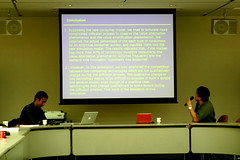
Originally uploaded by Zach Graham.
Timeouts Considered Harmful
Mike Shanahan never calls a timeout to ice the kicker because Jason Elam let him in on a little secret among the kicking fraternity: most of them like the extra time to check out the conditions.
The article goes on to quote several other kickers who say the timeout gives them a chance to get out on the field, go through their whole routine, fix up the field if they need to, and generally improves their chances of making the kick.
Vikings kicker Ryan Longwell says that coaches fear being second-guessed if they don’t try to ice the kicker: “So I think a lot of coaches do that just for that reason, to clear their conscience on using all the timeouts.”
This confirms a theory of mine, that a lot of things coaches — in any sport — do during a game are just for the sake of being seen to have done something, are not only not helpful, but probably harmful.
Nelson Algren Goes to Hollywood
From a 1955 interview with Nelson Algren in The Paris Review:
INTERVIEWER: How about this movie, The Man with the Golden Arm?
ALGREN: Yeah.
INTERVIEWER: Did you have anything to do with the script?
ALGREN: No. No, I didn’t last long. I went out there for a thousand a week. and I worked Monday, and I got fired Wednesday. The guy that hired me was out of town Tuesday.
Unrequited Love


I fell in love with a Cavalier King Charles Spaniel at the Irvine dog park last night. I kept showing off, trying to get her to play with me, but she just wanted to sit by her owner. When they left, I sat and stared out at the parking lot for a while . . .
P.S. I’m over it now though.
— Lightning 
The Overachiever
We’re celebrating my dad’s 70th birthday at Buca di Beppo in Brea.
“How’s Casey doing in school?” my dad asks. “Is he a 4.0 student?”
The boy, who’s sitting right there, says, “I’m a lot higher than that.”
“How can you be higher than 4.0?” I ask him.
“I’m an overachiever,” he says.
“You’re an overachiever?” my dad says.
“Yes, sir.”
The Greatest Golf Photo Ever
The facial expression on the guy in the back is priceless.
