

But will we make this new year worthy of its promise of true change or will we just go around in circles?
The Public School Monopoly Provides Little Incentive to Supply Good Education
[The public-school monopoly] is yet another scam that inflicts disproportionately great damage on people who are the poorest and least advantaged. How could it not? Those who run K-12 government schools aren’t paid by customers who voluntarily send their children to those schools and who could easily choose to send their children elsewhere. Instead, these teachers and officials are paid by governments that tax citizens regardless of how many children those citizens have in schools and regardless of how well the schools perform. Therefore, with funding that is independent of customer choice — and with each child assigned to a particular public school — public-school officials have little incentive to supply good education.
2014: The Year in Books
These are the books I read in 2014, roughly in the order listed. The ratings are mine. They don’t represent a consensus of opinion.
Books of the Year: My Antonia by Willa Cather (fiction) and Thinking, Fast and Slow by Daniel Kahneman (non-fiction).
Honorable Mention: Flaubert’s Parrot, The Fountain Overflows, Nausea, Pastoralia, Revolutionary Road.
Ovid Had Some Off Days
Ovid had some off days: "There is more refreshment and stimulation in a nap, even of the briefest, than in all the alcohol ever distilled."
— Broethius (@Broethius) December 30, 2014
Mo’ne Davis: Female Athlete of the Year?
Little League World Series star Mo’ne Davis made a big impression on the sports landscape in 2014—enough to garner Associated Press Female Athlete of the Year honors.

I can’t decide if this is demeaning only to female athletes or to women in general.
Reality check: Mo’ne Davis pitched two games for the Pennsylvania team in the 2014 Little League World Series — a 4-0 win and an 8-1 loss. Her team was knocked out in a semifinal game by the Nevada team, which went on to lose the final game to Illinois.
Would the AP ever select a little league baseball player (or other 13-year-old boy) as Male Athlete of the Year? Would the AP ever select a Male Athlete of the Year who has not distinguished himself among his peers and has zero notable accomplishments? Pitching and winning a Little League World Series game is not in itself a notable accomplishment. None of the boys who did it got any votes for 2014 AP Male Athlete of the Year.
The 2014 AP Male Athlete of the Year is, like Mo’ne Davis, a baseball pitcher: Madison Bumgarner of the San Francisco Giants. What did he do that was so special? Well, he was the MVP of both the NLCS and the World Series, in which he was 2-0 with a save, a 0.43 ERA, 17 strikeouts and one walk in 21 innings, which serves to emphasize what a joke the Female Athlete of the Year award is.
Clayton Kershaw finished second in the voting, followed by Derek Jeter, Rory McIlroy, Peyton Manning, Tim Howard, Lionel Messi, Tim Duncan, Aaron Rodgers, Novak Djokovic, Richard Sherman, Tom Brady, Thomas Mueller, Sidney Crosby, Marcus Mariota and LeBron James, all of whom distinguished themselves without qualification among the best athletes in their respective sports.
There’s no one in that list who is exceptional only under special pleading, e.g., he’s not a great soccer player but for a guy with one leg, he’s tremendous!
Sure, there are lots of better baseball players than Mo’ne Davis but she’s pretty good for a girl so let’s give her a big-time award.
R.I.P. America

Secondary Lobster

I’m thinking about getting into the secondary lobster market. Everyone’s so focused on main lobster, I’m thinking that secondary lobster may be an overlooked opportunity . . .
60 Million Students
#HourOfCode had an incredible first year. Thank you to all who helped propel this movement. http://t.co/bHAAWMYJiG. pic.twitter.com/IS1nU89XRe
— Code.org (@codeorg) December 29, 2014
Within the Circuit of this Plodding Life
Within the circuit of this plodding life,
There enter moments of an azure hue,
Untarnished fair as is the violet
Or anemone, when the spring strews them
By some meandering rivulet, which make
The best philosophy untrue that aims
But to console man for his grievances.
I have remembered when the winter came,
High in my chamber in the frosty nights,
When in the still light of the cheerful moon,
On every twig and rail and jutting spout,
The icy spears were adding to their length
Against the arrows of the coming sun,
How in the shimmering noon of summer past
Some unrecorded beam slanted across
The upland pastures where the Johnswort grew;
Or heard, amid the verdure of my mind,
The bee’s long smothered hum, on the blue flag
Loitering amidst the mead; or busy rill,
Which now through all its course stands still and dumb
Its own memorial,—purling at its play
Along the slopes, and through the meadows next,
Until its youthful sound was hushed at last
In the staid current of the lowland stream;
Or seen the furrows shine but late upturned,
And where the fieldfare followed in the rear,
When all the fields around lay bound and hoar
Beneath a thick integument of snow.
So by God’s cheap economy made rich
To go upon my winter’s task again.
Merry Christmas
From Downtown Disney:


Testing a White Privilege Theory

According to an article titled “The Thing About White Privilege,” “job applicants with white sounding names are 50% more likely to receive a callback for a job interview than applicants with black-sounding names, even when all job-related qualifications and credentials are the same.”
What happens when someone with an Asian-sounding name applies for a job? Serious question. Does the answer support a white privilege theory? What about someone with an Indian-sounding name? A Middle Eastern-sounding name? A Jewish-sounding name? An actual African-sounding name? Test your theories against reality rather than just slinging bullshit and ignoring information that inconveniences you.
I followed the link above and learned that “applicants with white names needed to send about 10 resumes to get one callback; those with African-American names needed to send around 15 resumes to get one callback.” That’s 10 percent vs. about 7 percent. Anyone who thinks “50% more likely” is the best way to express that is up to some shenanigans.
I would rather die having spoken after my manner, than speak in your manner and live. — Socrates
Most of Economics
Most of economics can be summarized in four words: “People respond to incentives.” The rest is commentary.
My Glasses Just Fell Apart for the Fourth Time

This little screw has just fallen out of my glasses for the fourth time since I got them, which causes the earpiece to fall off. When I buy cheap-ass reading glasses from, say, Target, they never fall apart. Only when I pay hundreds of dollars for the “real” frames do the screws fall out and the earpieces drop off . . .
Teaching Computer Science: Those Who Don’t Like to Read

I recommended a couple of books that I’ve read recently and liked — Unbroken by Laura Hillenbrand and Thinking, Fast and Slow by Daniel Kahneman — to the class in case anyone was looking for a book to read over winter break or maybe as a holiday gift.
“What if you don’t like to read?” someone asked.
“Well, in that case you can spend your entire life inside your own head and never know or care what life looks like to other people.”
In hindsight, it occurred to me that I could have suggested audio books for people who don’t like to read, but . . . woulda coulda shoulda, you know what I’m saying?
Many Have Long Known …
Many in academia have long known about how the practice of student evaluations of professors is inherently biased against female professors. . . .
- Group A getting better evaluations than Group B is not evidence of bias.
- Asserting that something is true doesn’t mean it’s true.
- Asserting that many people know something to be true doesn’t mean it’s true.
- Most college students (i.e., the people evaluating professors) are female. What, if anything, does this fact suggest?
Thinking, Fast and Slow by Daniel Kahneman
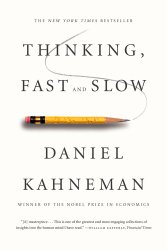
The notion that we have limited access to the workings of our minds is difficult to accept because, naturally, it is alien to our experience but it is true: You know far less about yourself than you feel you do.
A reliable way to make people believe in falsehoods is frequent repetition, because familiarity is not easily distinguished from truth.
It is the consistency of information that matters for a good story, not its completeness. Indeed, you will often find that knowing little makes it easier to fit everything you know into a coherent pattern.
The exaggerated faith in small samples is only one example of a more general illusion — we pay more attention to the content of messages than to information about their reliability, and as a result end up with a view of the world around us that is simpler and more coherent than the data justify.
Narrative fallacies arise inevitably from our continuous attempt to make sense of the world. The explanatory stories that people find compelling are simple; are concrete rather than abstract; assign a larger role to talent, stupidity, and intentions than to luck; and focus on a few striking events that happened rather than on the countless events that failed to happen.
Hindsight bias has pernicious effects on the evaluations of decision makers. It leads observers to assess the quality of a decision not be whether the process was sound but by whether its outcome was good or bad. . . . This outcome bias makes it almost impossible to evaluate a decision properly – in terms of the beliefs that were reasonable when the decision was made.
Stories of how businesses rise and fall strike a chord with readers by offering what the human mind needs: a simple message of triumph and failure that identifies clear causes and ignores the determinative power of luck and the inevitability of regression. These stories induce and maintain an illusion of understanding, imparting lessons of little enduring value to readers who are all too anxious to believe them.
For some of our most important beliefs we have no evidence at all, except that people we love and trust hold those beliefs.
Confidence is a feeling, which reflects the coherence of the information and the cognitive ease of processing it. It is wise to take admissions of uncertainty seriously, but declarations of high confidence mainly tell you that an individual has constructed a coherent story in his mind, not necessarily that the story is true.
We know that people can maintain an unshakable faith in any proposition, however absurd, when they are sustained by a community of like-minded believers.
The idea that the future is unpredictable is undermined every day by the ease with which the past is explained. . . Everything makes sense in hindsight . . . And we cannot suppress the powerful intuition that what makes sense in hindsight was predictable yesterday. The illusion that we understand the past fosters overconfidence in our ability to predict the future.
[Philip Tetlock, a psychologist at the University of Pennsylvania] interviewed 284 people who made their living “commenting or offering advice on political and economic trends. . . . In all, Tetlock gathered more than 80,000 predictions. . . . Respondents were asked to rate the probabilities of three alternative outcomes in every case: the persistence of the status quo, more of something such as political freedom or economic growth, or less of that thing.
The results were devastating. The experts performed worse than they would have if they had simply assigned equal probabilities to each of the three potential outcomes. In other words, people who spend their time, and earn their living, studying a particular topic produce poorer predictions than dart-throwing monkeys who would have distributed their choices evenly over the options. Even in the region they knew best, experts were not significantly better than nonspecialists.
Rehearse the mantra that will get you significantly closer to economic reality: you win a few, you lose a few.
Nothing in life is as important as you think it is when you are thinking about it.
During the last 10 years we have learned many new facts about happiness. But we have also learned that the word happiness does not have a simple meaning and should not be used as if it does. Sometimes scientific progress leaves us more puzzled than we were before.
Sugar Substitutes

I’m trying to find some sugar for my coffee in the break room . . . I see three kinds of sugar substitute — the pink kind, the yellow kind and the blue kind — but no actual sugar. The number of sugar substitutes concerns me. Why are there three different kinds? It’s like they’re not only substitutes for sugar, they’re substitutes for the other sugar substitutes.
Sugar is a natural substance that grows from the earth. I don’t know what any of this other shit is and therefore I’m not putting it in my coffee . . .
Merry Christmas from Irvine

Old Wine
If I could lift
My heart but high enough
My heart could fill with love:But ah, my heart
Too still and heavy stays
Too brimming with old days.