


The National World War II Memorial opened today in Washington, D.C.
My dad served in World War II. He’d be so proud and excited if he hadn’t been dead for 25 years.
The National World War II Memorial opened today in Washington, D.C.
My dad served in World War II. He’d be so proud and excited if he hadn’t been dead for 25 years.
Let us recollect that peace or war will not always be left to our option; that however moderate or unambitious we may be, we cannot count upon the moderation, or hope to extinguish the ambition of others.
“Don’t fart when I’m talking!”
“Don’t start talking when I’m about to fart!”
Ill-specified systems are as common today as they were when we first began to talk about Requirements Engineering twenty or more years ago. Yet the task of creating complete and perfect specifications is not rocket science. We have adequate and comprehensible theories at our disposal for specification of finite state automata. We have proceeded over the past decades to develop and refine a discipline of applying these theories to real-world systems. In our methodological focus, we may have lost sight of some endemic problems that plague not the process but the people who do the process. Is it possible that an engineering approach to requirements is as badly suited to our real need as would be an engineering approach to raising teenagers? I’m beginning to think so . . .

There are zillions of books on how to raise kids, and I think my wife has read most of them, along with countless magazine articles . . .
In fact, she’s far more open to taking child-rearing advice from books and magazines than she is from me, despite the fact that none of the authors has ever met our kid, and can therefore offer no insight into our particular situation.
But how comforting must it be to think that there’s a “methodology” for raising kids or for building good software — that someone has already solved all the hard problems for us . . . that we don’t have to rely solely on our own judgment to make critical decisions when we have only a limited amount of time, a limited amount of information, and no certain knowledge of the consequences . . .
Thus spoke The Programmer.
Also, whether I died now or forty years hence, this business of dying had to be got through, inevitably. Still, somehow this line of thought wasn’t as consoling as it should have been . . .
I’m letting my subscription to Real Simple magazine expire. I’ve been taking it for a year and my life didn’t get any simpler.
In fact, it got more complicated because I had one more magazine to read . . .
My son, with mock pathos, is explaining to his mom how he managed to mess up a word definition on his homework:
I’m a little boy, not a Merriam-Webster dictionary!

The ability to ignore costs is at the heart of the attraction of government for some and of the expansion of government over time. Anything that might conceivably be of some benefit to someone, sometime, is worth doing, if someone else is paying. In our own lives, we pass up all sorts of benefits when we decide that they are just not worth their cost. Maybe we would like to have a new car or add another room onto the house or take a vacation in the Caribbean but it may not be worth what it would cost. So we keep driving the old jalopy, get used to not having a den and take in a few ball games during the summer instead of going on a cruise. Life is full of trade-offs when it is your own money.
C.K. Prahalad, one of the leading strategic consultants, has said that a mission statement should take less than three minutes to explain to an audience.

That is absolute horseshit.
Imagine making a declarative statement and then having to take an additional three minutes to explain what you just said.
A mission statement should be immediately comprehensible. Three minutes of explanation is three minutes too many.
I read a book on George Patton this weekend. Here is his mission statement for the Third Army:
I don’t want to get any messages saying that “we are holding our position.” We’re not holding anything! Let the Hun do that. We are advancing constantly and we’re not interested in holding on to anything except the enemy. We’re going to hold on to him by the nose and we’re going to kick him in the ass.
And most of that I included just for context. It really could be shortened to
We’re going to hold the enemy by the nose and we’re going to kick him in the ass.
It clearly states the goal of the organization, and it doesn’t need a three-minute explanation, does it?
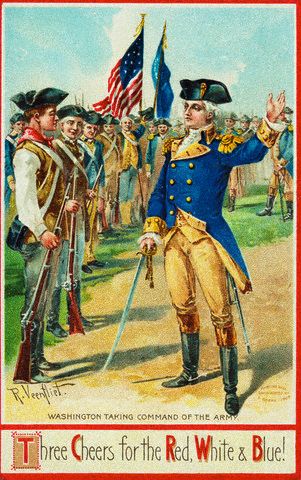
On this date in 1775, the first shots in the Revolutionary War were fired at Lexington and Concord . . .
By the rude bridge that arched the flood,
Their flag to April’s breeze unfurled,
Here once the embattled farmers stood
And fired the shot heard round the world.The foe long since in silence slept;
Alike the conqueror silent sleeps;
And Time the ruined bridge has swept
Down the dark stream which seaward creeps.On this green bank, by this soft stream,
We set to-day a votive stone;
That memory may their deed redeem,
When, like our sires, are sons are gone.Spirit, that made those heros dare
To die and leave their children free,
Bid Time and Nature gently spare
The shaft we raise to them and thee.
My son is reading a biography of John Lennon. Here’s what he got out of it so far:
“John Lennon got all Cs in school.”
I think his mom is going to take the book away from him . . .
“And she’ll have fun, fun, fun till her daddy takes the TV away!”
“It’s T-Bird . . . not TV.”
“What’s a T-Bird?”
The new Spanish government will soon meet with Germany and France to craft a ‘European’ approach to terrorism. Topic No. 1: How big should the white flag be? Oak or cedar for the pole?
We come to work, have lunch, and go home. We goose-step in and goose-step out, change our partners and wander all about, sashay around for a pat on the head, and promenade home till we all drop dead.
I feel like work gives my life the illusion of meaning. On the other hand, it really cuts into my day.
Dilemma . . .
There can never be defeat if a man refuses to accept defeat. Wars are lost in the mind before they are lost on the ground. No nation was ever defeated until the people were willing to accept defeat.

Photo Gallery: The USC national championship football and women’s volleyball teams are honored by President George W. Bush in a ceremony held at the White House.
Depression occurs in up to 10 percent of youth, and 1,883 10- to 19-year-olds killed themselves in 2001. Some 1.8 million teenagers attempted suicide that year, a quarter of them requiring medical attention, according to Columbia University scientists . . .
Out of 1.8 million attempts, only 1,883 successes?! What methods are they employing to get a success rate of 1 in 1,000?
That’s not very good . . .
More whittling away at logic and critical thinking . . .
WASHINGTON (AP) — Patients on some popular antidepressants should be closely monitored for warning signs of suicide, the government warned Monday in asking the makers of 10 drugs to add the caution to their labels.

